

Patient activation clinical research outcomes have become one of the most scrutinized variables in chronic disease trials, yet most study designs still treat activation as an afterthought rather than a primary construct. Researchers who integrate validated measures like PAM-13 from the protocol design stage consistently generate richer, more interpretable data. This guide walks through every phase: selecting the right measurement tools, designing studies that capture activation change meaningfully, executing interventions without common pitfalls, and analyzing results with the statistical rigor the field now demands.
Table of Contents
- Key Takeaways
- Patient activation clinical research outcomes: the measurement foundation
- Designing studies that capture activation change
- Executing interventions and avoiding common pitfalls
- Analyzing the impact of patient activation on outcomes
- My perspective on where this field still falls short
- How Tillsammans.app supports your research
- FAQ
Key Takeaways
| Point | Details |
|---|---|
| Validate your measurement tool early | PAM-13 is the gold standard for measuring patient activation; build it into your protocol before data collection begins. |
| Separate activation from clinical endpoints | Activation gains often precede biomarker changes by months; plan follow-up timelines accordingly. |
| Stratify by baseline activation level | Patients at PAM Level 1 and 2 show the greatest gains from tailored interventions; targeting them maximizes effect size. |
| Test mediators empirically | Assumed pathways between activation and adherence frequently do not hold; run mediation models on your actual data. |
| Partner with patients across the lifecycle | Meaningful patient engagement in research design improves relevance, recruitment, and downstream adoption of findings. |
Patient activation clinical research outcomes: the measurement foundation
Before you can study the impact of patient activation, you need a precise, consistent way to quantify it. The PAM-13 is the most widely validated instrument for this purpose. It is a 13-item Likert scale that converts responses into a 0 to 100 score, stratified into four activation levels ranging from passive disengagement to proactive self-management.
Understanding what each level represents matters for research design, not just clinical care. A patient scoring in Level 1 lacks the confidence and knowledge to manage their condition. A Level 4 patient actively maintains healthy behaviors even under stress. These are fundamentally different behavioral profiles, and interventions designed without accounting for them will produce noisy, hard-to-interpret data.
Key dimensions PAM-13 captures:
- Knowledge: Does the patient understand their condition and treatment options?
- Skills: Can they execute self-management tasks like medication tracking or symptom monitoring?
- Confidence: Do they believe their actions will produce meaningful health outcomes?
PAM-13 has real strengths for research contexts. It is brief enough to administer repeatedly across follow-up visits without burdening participants, and its scoring structure allows for both group-level analysis and individual trajectory tracking. The limitation researchers encounter most often is ceiling effects in highly educated or motivated samples, which compresses variance and reduces sensitivity to change.
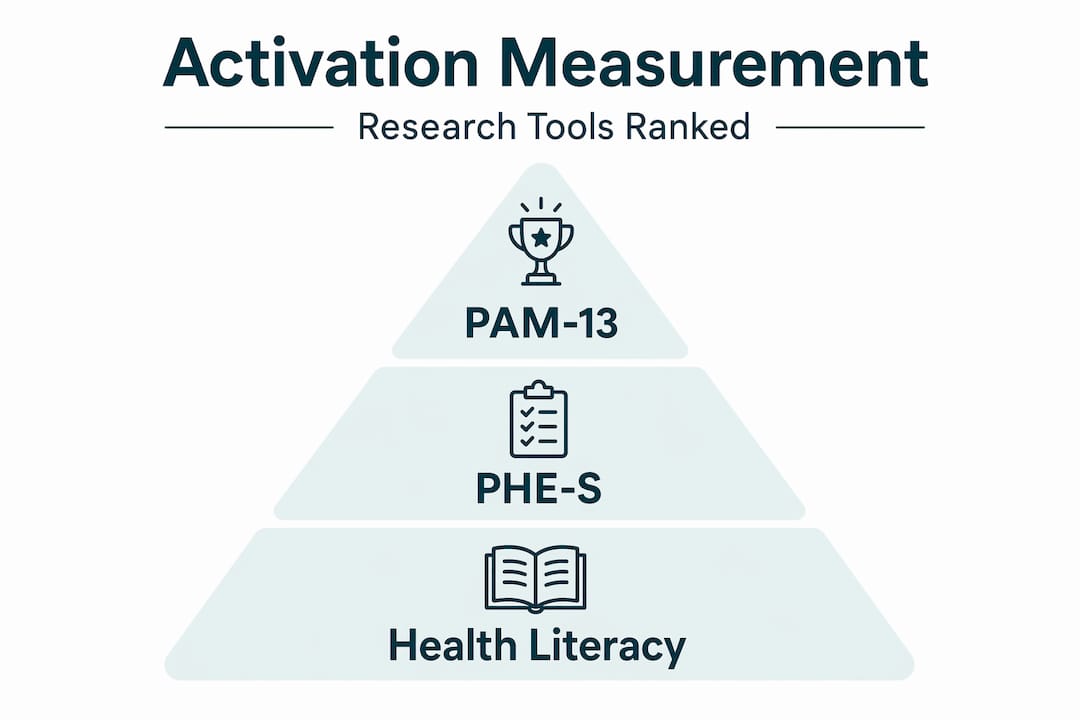
Other instruments worth knowing include the Patient Health Engagement Scale (PHE-S) and the Health Literacy Questionnaire (HLQ). PHE-S captures emotional and relational dimensions of engagement that PAM-13 does not, but research has shown the direct pathway from PHE-S to medication adherence is weak and non-significant (β=0.03, p=.60). That finding should caution you against substituting engagement proxies for activation measures and assuming the pathways are equivalent.
Pro Tip: If your study population includes patients with low health literacy, consider pairing PAM-13 with a brief literacy screen at baseline. Activation scores in low-literacy groups may reflect comprehension barriers rather than true motivational deficits, and that distinction changes how you interpret and report your results.
Designing studies that capture activation change
Rigorous study design for patient-centered research outcomes starts with decisions made well before the first participant is enrolled. Three preparation areas determine whether your activation data will be interpretable at the end.
-
Define your population with activation in mind. Research on type 2 diabetes patients shows that older age and higher HbA1c are independently linked to lower activation levels, with an adjusted R² of 0.759 for the full predictive model. If your study does not account for these demographic and clinical covariates at baseline, you risk confounding your activation effects with population-level differences that have nothing to do with your intervention.
-
Embed PAM-13 into the protocol at every time point. A single baseline measure tells you where patients start. It does not tell you how activation changes in response to your intervention, nor does it let you model activation as a mediator between treatment and clinical outcomes. Build in assessments at baseline, midpoint, and primary endpoint at minimum.
-
Plan your follow-up timeline around the biology of behavior change. This is where most studies underestimate the time required. Activation is a behavioral readiness marker, and clinical endpoints require longer horizons to reflect the downstream effects of improved self-management. A 12-week trial may show significant activation gains while HbA1c, blood pressure, or BMI remain unchanged. That is not a null result. It is a sequencing result, and your design needs to accommodate that interpretation.
| Study phase | PAM-13 role | Clinical outcome role |
|---|---|---|
| Baseline | Stratification variable | Eligibility screening |
| Midpoint (8–12 weeks) | Intermediate endpoint | Safety monitoring |
| Primary endpoint (6–12 months) | Change score analysis | Efficacy endpoint |
| Long-term follow-up (12+ months) | Maintenance tracking | Behavioral and biomarker outcomes |
Ethical considerations deserve more than a checkbox in your IRB submission. Meaningful patient engagement means involving patients as partners across the research lifecycle, not just as data sources. PCORI's framework emphasizes structured partnerships that go beyond recruitment and consent. Practically, this means consulting patient advisory groups when selecting outcome measures, reviewing study materials for plain-language accessibility, and incorporating patient feedback into protocol amendments.

Pro Tip: Run a small pilot with 10 to 15 patients before finalizing your PAM-13 administration protocol. Identify whether participants interpret items consistently, and check whether your data collection platform captures scores accurately before scaling up.
Executing interventions and avoiding common pitfalls
With your protocol set, execution quality determines whether your activation data reflects real behavioral change or measurement artifact. Here is a structured approach to implementation.
-
Match intervention intensity to baseline PAM level. Patients at PAM Level 1 and 2 show the greatest activation gains from tailored interventions. High-intensity coaching or peer support programs are most efficient when directed at this group. Patients already at Level 3 or 4 benefit from maintenance-focused strategies rather than foundational education.
-
Build in structured re-assessment at the midpoint. Activation is dynamic. A patient who enters at Level 2 may reach Level 3 within eight weeks, at which point their intervention needs shift. Studies that lock participants into a fixed intervention track regardless of activation trajectory miss the opportunity to optimize outcomes.
-
Use mixed methods to capture mechanism, not just magnitude. Quantitative PAM-13 scores tell you that activation changed. Qualitative interviews or patient diaries tell you why. For patient-centered research outcomes, the mechanism matters as much as the effect size, particularly when you are trying to translate findings into clinical practice guidelines.
-
Track clinical outcomes with appropriate lag expectations. A quasi-experimental study in a tertiary care setting showed significant activation gains (p=0.004) within three months, but no significant short-term changes in clinical biomarkers. Researchers who interpret this as intervention failure misread the data entirely.
Common pitfalls that compromise execution:
- Using PAM-13 as a one-time screen rather than a longitudinal measure
- Failing to train research staff on neutral, non-leading administration of activation assessments
- Conflating patient satisfaction scores with activation scores (they measure different constructs)
- Overloading participants with assessment burden, which reduces completion rates and introduces attrition bias
- Assuming that any engagement-focused activity will improve activation without testing the specific mechanism
Maintaining patient engagement in research over multi-month follow-up periods requires deliberate effort. Regular check-ins, clear communication about study progress, and feedback loops that show participants how their data contributes to findings all reduce dropout. Structured peer coaching platforms have shown particular promise here, especially for chronic disease populations where social isolation compounds low activation.
Analyzing the impact of patient activation on outcomes
Once your data is collected, the analytical choices you make determine whether your findings advance the field or add noise to it.
Mediation analysis is the most appropriate framework for most patient activation clinical research outcomes questions. You are typically asking whether activation change mediates the relationship between an intervention and a clinical endpoint, not whether activation directly causes the endpoint in isolation. Path analysis and structural equation modeling allow you to test these indirect pathways while controlling for confounders.
Key analytical considerations:
- Test your mediators empirically. Research consistently shows that assumed mediation pathways often do not hold when subjected to rigorous modeling. The conceptual logic may be sound, but the empirical data may reveal a different story. Build your analysis plan around what the data shows, not what the theory predicts.
- Report activation change as an intermediate outcome, not a surrogate endpoint. Activation scores are not a substitute for clinical biomarkers. They are a leading indicator of behavioral readiness. Frame them accordingly in your results and discussion sections.
- Account for moderators. Patient-provider relationship quality, health literacy, and socioeconomic status all moderate the relationship between activation and clinical outcomes. A significant association between PAM-13 and medication adherence (β=0.20, p<.05) in a general diabetes population may not replicate in a low-income subgroup without additional support structures.
- Use longitudinal mixed-effects models when you have repeated PAM-13 measures. These models handle missing data more gracefully than simple pre-post comparisons and allow you to model individual activation trajectories rather than just group means.
"Patient activation should be understood as a behavioral readiness intermediate outcome. Clinical endpoints require longer time horizons to manifest changes, and researchers who design studies without this distinction built in will consistently underestimate intervention effects."
When reporting findings, be specific about which PAM-13 level shifts occurred and in which subgroups. A mean score increase of 5 points means something very different if it moves a cluster of patients from Level 1 to Level 2 versus from Level 3 to Level 4. That granularity is what makes your findings useful to clinicians designing how to improve patient activation in real practice settings.
My perspective on where this field still falls short
I've spent considerable time working at the intersection of patient engagement in research and clinical outcomes measurement, and the pattern I keep seeing is the same. Researchers design studies with activation as a secondary outcome, collect PAM-13 data inconsistently, and then struggle to interpret what their numbers mean when the clinical endpoints do not move.
The honest truth is that measuring patient activation is the easy part. The hard part is designing studies long enough and flexible enough to capture the behavioral cascade that activation sets in motion. I've seen well-funded trials report "no significant clinical improvement" at six months when their activation data clearly showed that patients were just beginning to build the self-management habits that would have produced biomarker changes by month twelve.
What I think the field needs most right now is not better measurement tools. We have PAM-13. What we need are better longitudinal designs, more willingness to treat activation change as a meaningful primary endpoint in its own right, and genuine patient partnership that goes beyond advisory boards into co-design of interventions and outcome selection.
The researchers who will produce the most impactful work in this space are the ones who stop treating activation as a covariate to control for and start treating it as the central mechanism worth understanding. That shift in framing changes everything about how you design, execute, and report your studies.
— Fredrik
How Tillsammans.app supports your research
Emotionalfitness built Tillsammans.app specifically to address the gap between measuring patient activation and actually moving it. For researchers working on chronic disease management trials, the platform provides structured peer coaching that generates real-world activation data alongside engagement metrics.
The quasi-experimental intervention study referenced throughout this guide used a platform model consistent with Tillsammans.app's approach: tailored activation-level coaching, repeated PAM-13 assessment, and peer-to-peer support that sustains engagement between clinical visits. The result was significant activation gains within three months in a tertiary care population. For researchers looking to integrate a validated, data-generating engagement platform into their study design, Emotionalfitness offers pharmaceutical and research partnerships through Tillsammans.app that include anonymized, aggregated patient insights to complement your clinical data collection.
FAQ
What is patient activation and why does it matter in clinical research?
Patient activation refers to a patient's knowledge, skills, and confidence to manage their own health. In clinical research, it predicts medication adherence, self-management behavior, and long-term clinical outcomes, making it a valuable intermediate endpoint in chronic disease trials.
How is PAM-13 used to measure patient activation?
PAM-13 is a validated 13-item scale that scores patients from 0 to 100 across four activation levels. Researchers use it at multiple time points to track activation change as an intermediate outcome in clinical trials.
Why don't clinical biomarkers always improve when activation scores rise?
Activation improvements reflect behavioral readiness, not immediate physiological change. Research shows activation gains precede biomarker shifts by months, which means studies with short follow-up periods will frequently miss downstream clinical effects.
Which patients benefit most from activation-focused interventions?
Patients starting at PAM Level 1 or 2 show the greatest gains from tailored interventions. Stratifying your study population by baseline activation level and directing higher-intensity support to lower-activation participants maximizes both effect size and clinical relevance.
How should mediation be tested in patient activation studies?
Mediation pathways between activation and clinical outcomes should be tested empirically using path analysis or structural equation modeling. Conceptual assumptions about mediators frequently do not hold in real data, and empirical mediation testing produces more accurate intervention targeting and clearer mechanistic conclusions.