

Patient compliance doesn't fail because people forget to take their pills. It fails because they don't believe their provider is truly on their side. Understanding why trust improves patient compliance is one of the most clinically significant questions in modern healthcare, and the evidence is no longer soft or anecdotal. Trust is a measurable, modifiable factor that directly shapes whether patients fill prescriptions, attend follow-ups, and engage in self-management. This article unpacks the mechanisms, the data, and the practical strategies that translate trust into better adherence and outcomes.
Table of Contents
- Key Takeaways
- Why trust improves patient compliance: the core mechanism
- Factors that build and undermine trust in clinical settings
- Evidence linking trust levels to compliance and outcomes
- Practical strategies to build trust and improve compliance
- Nuances and challenges in applying trust research
- My take: trust is not a soft metric, it's a clinical outcome
- How Emotionalfitness supports trust-based patient engagement
- FAQ
Key Takeaways
| Point | Details |
|---|---|
| Trust is clinically measurable | National surveys track trust levels and link them directly to patient adherence and health outcomes. |
| Continuity of care drives trust | Patients who see the same provider repeatedly report higher confidence and are more likely to follow medical advice. |
| Mistrust is a systemic barrier | Marginalized populations face compounding trust deficits rooted in past discrimination and poor communication. |
| Communication is the core lever | Providers who manage expectations and practice active listening see measurable improvements in medication adherence. |
| Peer support fills the gap | Structured community platforms can reinforce trust-based engagement when clinical contact is limited. |
Why trust improves patient compliance: the core mechanism
Trust, in a clinical context, is not simply goodwill. It is a patient's willingness to accept vulnerability based on the belief that their provider will act in their best interest. That definition matters because it explains the direct behavioral pathway from trust to compliance. When a patient trusts their clinician, they lower their psychological defenses. They share symptoms they might otherwise hide, ask questions they might otherwise suppress, and follow advice they might otherwise dismiss.
Research published in Frontiers in Psychology describes trust as reducing uncertainty in vulnerable clinical interactions, which directly impacts adherence. That reduction in uncertainty is the mechanism. A patient who is uncertain whether their doctor understands their life, their fears, or their cultural context will hedge. They will take half the dose, skip the follow-up, or seek a second opinion from a neighbor instead of a specialist.
Trust operates across five core components in the clinical relationship:
- Caring: Does the provider demonstrate genuine concern for the patient's wellbeing?
- Competence: Does the patient believe the provider has the technical skill to help them?
- Communication: Is information delivered clearly, with room for questions?
- Empathy: Does the provider acknowledge the emotional weight of illness?
- Continuity: Is there a consistent, ongoing relationship rather than a series of strangers?
Each component contributes independently to the trust equation, and each has its own pathway to compliance. A patient may trust a provider's competence but distrust their empathy, which is often enough to derail medication adherence for conditions that carry stigma, such as mental health disorders or HIV.
"Trust is not a soft skill. It is the clinical infrastructure through which every other intervention is delivered."
Factors that build and undermine trust in clinical settings
Understanding what builds trust is as important as understanding why it matters. The factors are neither mysterious nor beyond clinical control.
-
Communication quality. Providers who manage patient expectations, explain the reasoning behind treatment decisions, and actively listen to concerns build trust faster and sustain it longer. The inverse is equally true. When providers focus on clinical priorities while patients seek relational, humanistic connection, the gap erodes trust in ways that rarely get flagged in a clinical note.
-
Continuity of care. Seeing the same provider repeatedly is one of the strongest structural predictors of patient trust. Cross-sectional data from English general practices shows that higher continuity and face-to-face appointments significantly correlate with higher confidence and trust scores. Every time a patient has to re-explain their history to a new face, a small withdrawal is made from the trust account.
-
Technical competence and professionalism. Patients are not naive. They notice when a provider is uncertain, dismissive, or rushed. Perceived competence is a prerequisite for trust, not a bonus.
-
Systemic and structural factors. Transactional care models, reduced appointment times, and limited access to preferred physicians all chip away at the relational foundation that trust requires. These are not individual provider failures. They are system-level trust deficits.
-
Medical mistrust in marginalized communities. This is where the stakes are highest. Qualitative research on Black African and Black Caribbean patients in South East London found that mistrust stems from past discrimination and inadequate communication, directly limiting medication adherence for hypertension. Patients who feel excluded from treatment decisions don't just disengage. They disengage silently, which makes the problem invisible to the provider.
Pro Tip: When working with patients from communities with documented histories of medical discrimination, name the mistrust directly. Acknowledging the legitimacy of their skepticism is often more trust-building than any clinical explanation.
Evidence linking trust levels to compliance and outcomes
The data on this topic has matured significantly. We are past the point of arguing that trust probably matters. The numbers now tell a specific story.
The UK GP Patient Survey tracks a question that operationalizes trust precisely: "Did you have confidence and trust in the clinician you saw?" The trend is not encouraging. Trust declined from 69.2% in 2018 to 64.4% in 2023, while the proportion reporting no trust at all rose from 4% to 7%. These shifts coincide directly with the move toward more transactional, less relational care models.
| Year | "Definitely had confidence and trust" | "No trust" |
|---|---|---|
| 2018–2019 | 69.2% | 4% |
| 2023–2024 | 64.4% | 7% |
At the individual level, the effect sizes are clinically meaningful. A meta-analysis examining adherence to antiretroviral therapy among youth living with HIV found that positive patient-provider relationships were associated with an odds ratio of 1.76 for adherence. An OR of 1.76 means patients in high-trust relationships were 76% more likely to adhere to their regimen than those in low-trust relationships. That is not a marginal effect. It is the kind of effect size that would make a new drug headline news.
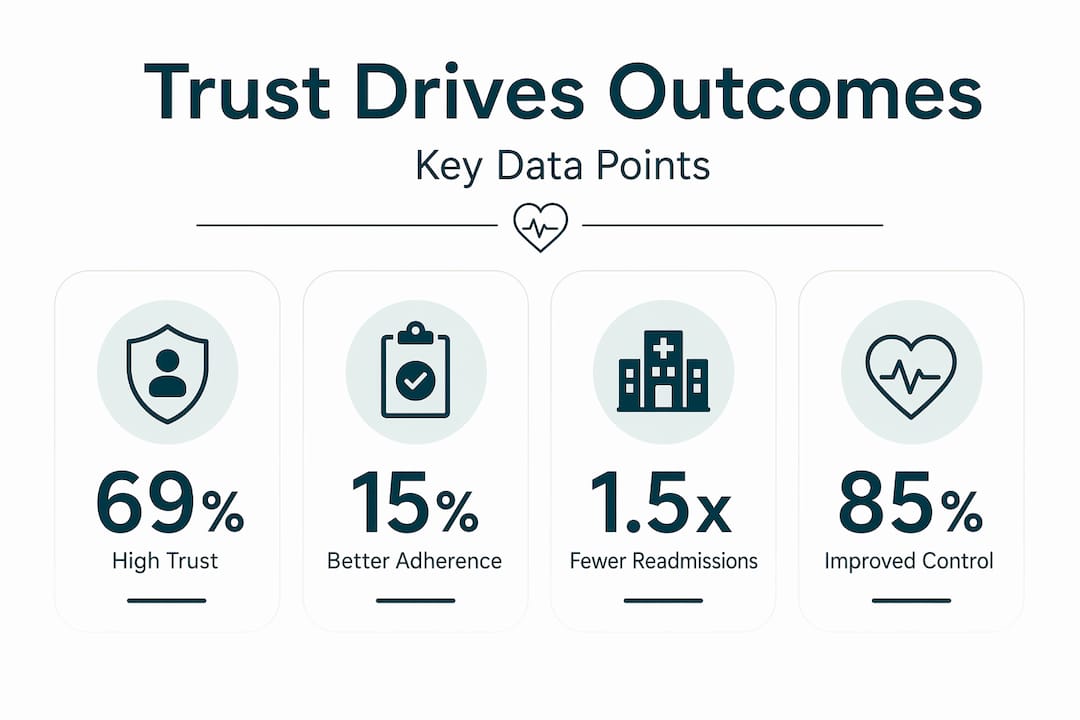
The adherence rates in those studies ranged from 20% to 93.8%, which itself tells you something important: adherence is not fixed. It is highly sensitive to relational context. Trust is one of the most powerful modulators of where a patient lands on that spectrum.
Beyond adherence, patient trust is linked to fewer readmissions and better self-management of chronic conditions. These are downstream outcomes that matter enormously to health systems managing costs and capacity.

Practical strategies to build trust and improve compliance
The evidence is clear. The question for clinicians and health system designers is what to do with it. Here is where the research translates into practice.
Communication-centered approaches:
- Practice shared decision-making. Patients who participate in treatment decisions are more likely to follow through on them because the plan belongs to them, not just to the clinician.
- Manage expectations explicitly. Tell patients what to expect from a treatment, including side effects and timelines. Unmet expectations are a primary driver of trust erosion.
- Apply cultural humility, not just cultural competence. The distinction matters. Competence implies mastery of a fixed body of knowledge about a group. Humility implies ongoing curiosity about the individual in front of you.
Structural and system-level approaches:
Promoting continuity of care is the highest-leverage system intervention available. System redesign favoring continuity is a practical leverage point to sustain patient trust and long-term adherence. This means resisting the temptation to optimize purely for throughput at the expense of relationship.
| Approach | Trust impact | Compliance impact |
|---|---|---|
| Shared decision-making | High | High |
| Continuity of care | Very high | High |
| Cultural humility training | High | Moderate to high |
| Health literacy improvement | Moderate | High |
| Peer coaching and community support | Moderate | High |
Addressing mistrust directly:
For patients with documented or suspected medical mistrust, patient-centered consultations that explicitly invite questions and acknowledge past negative experiences are more effective than standard consultations. Training programs that enhance provider communication and build awareness of trust dynamics improve care quality in measurable ways.
Pro Tip: Peer coaching programs, where patients with shared experiences support each other's adherence, can extend the relational trust function beyond the clinical encounter. This is especially valuable in chronic condition management where daily self-management decisions happen far from the clinic.
Nuances and challenges in applying trust research
Trust research is not without its complications, and applying it well requires acknowledging where the picture gets complex.
- Demographic variability. Trust levels and their drivers differ significantly by patient age, ethnicity, and socioeconomic status. Older patients may weight continuity more heavily; younger patients may prioritize digital access and communication style. One-size interventions will underperform.
- Declining primary care access. The shift toward telehealth and same-day access models, while expanding reach, often reduces the continuity that builds trust. The decline in preferred physician access correlates directly with lower trust scores in UK data.
- Measurement limitations. Survey-based trust measures capture a moment in time and may not reflect the dynamic, relational nature of trust as it builds or erodes across multiple encounters.
- Unintended effects. Interventions designed to build trust can backfire if they feel performative. Patients are perceptive. A scripted empathy exercise delivered by a visibly rushed clinician may do more harm than a brief, genuine acknowledgment.
- Research gaps. Most high-quality adherence studies focus on specific populations or conditions. Generalizing findings across chronic disease contexts requires caution and continued investment in tailored research.
My take: trust is not a soft metric, it's a clinical outcome
I've spent years working at the intersection of patient engagement and chronic condition management, and the pattern I keep seeing is the same. Clinicians who are technically excellent but relationally inconsistent produce patients who are technically informed but behaviorally disengaged. The information lands. The behavior doesn't change.
What I've learned is that trust is not something that happens between appointments. It is built or broken in the first two minutes of every encounter. The way a provider enters a room, whether they look at the patient or the screen, whether they pause before speaking. These micro-signals are the actual currency of trust.
The uncomfortable truth I've come to accept is that healthcare systems are structurally hostile to trust-building. Appointment times are shrinking. Rosters are expanding. Continuity is being traded for access. And then we wonder why adherence rates are flat despite better drugs and better guidelines.
What actually works, in my experience, is building relational infrastructure outside the clinical encounter. Platforms like Tillsammans.app that create consistent, peer-supported touchpoints between appointments don't replace the clinician relationship. They extend it. They keep patients engaged, accountable, and emotionally supported in the spaces where clinical trust can't reach.
The providers I've seen achieve the best adherence outcomes are the ones who recognize that they are not the only trust relationship in a patient's life. They build networks of support around their patients rather than trying to carry the entire relational load themselves.
— Fredrik
How Emotionalfitness supports trust-based patient engagement
Healthcare providers and researchers who understand the trust-compliance relationship often face the same frustrating gap: the evidence is clear, but the tools to act on it at scale are limited.
Emotionalfitness, through Tillsammans.app, addresses this gap directly. The platform creates structured peer coaching environments where patients with chronic conditions support each other's adherence between clinical encounters. This reciprocal model reinforces the trust-based engagement that drives compliance, without adding to provider workload. Aggregated, anonymized insights from these interactions also give healthcare actors a clearer picture of what their patients actually need. If you're looking to translate trust research into measurable patient outcomes, explore what Tillsammans.app offers for pharmaceutical and healthcare partnerships.
FAQ
Why does trust improve patient compliance?
Trust reduces the psychological uncertainty patients feel about their treatment, making them more willing to follow medical advice, take medications consistently, and attend follow-up appointments. Research shows positive provider relationships are associated with an odds ratio of 1.76 for treatment adherence.
What factors most affect patient trust in clinical settings?
Continuity of care, provider communication quality, and perceived competence are the strongest drivers of patient trust. Data from English general practices shows that face-to-face appointments with the same provider significantly increase confidence and trust scores.
How has patient trust in clinicians changed recently?
UK survey data shows that the proportion of patients who "definitely" trust their clinician dropped from 69.2% in 2018 to 64.4% in 2024, while those reporting no trust rose from 4% to 7%, coinciding with more transactional care models.
How does medical mistrust affect medication adherence?
Medical mistrust, particularly in communities with histories of discrimination, creates a direct barrier to medication adherence. Patients who feel excluded from treatment decisions are less likely to follow prescribed regimens, as documented in qualitative research on antihypertensive adherence among Black African and Black Caribbean patients.
What can healthcare systems do to build patient trust at scale?
Prioritizing continuity of care, training providers in cultural humility and shared decision-making, and supplementing clinical contact with peer coaching programs are the most evidence-supported approaches to building trust and improving compliance across patient populations.